Demand, planning and scheduling
Connect demand forecasts, sales and operations planning, master production schedules, capacity planning, material requirements, work-centre constraints and production sequencing.
↗ Book a Discovery Session
INDUSTRY SOLUTIONS / MANUFACTURING
Manufacturing depends on the alignment of demand, materials, machines, people, quality and delivery. When one part falls out of step, the impact can travel across the entire operation.
Intellixio helps manufacturing organisations connect business workflows, operational information and decision-making — with automation and integrations scoped to the systems and controls already in place.
Designed around production realities, quality requirements and operational governance.
Plan and output
Results and actions
Maintenance workflow
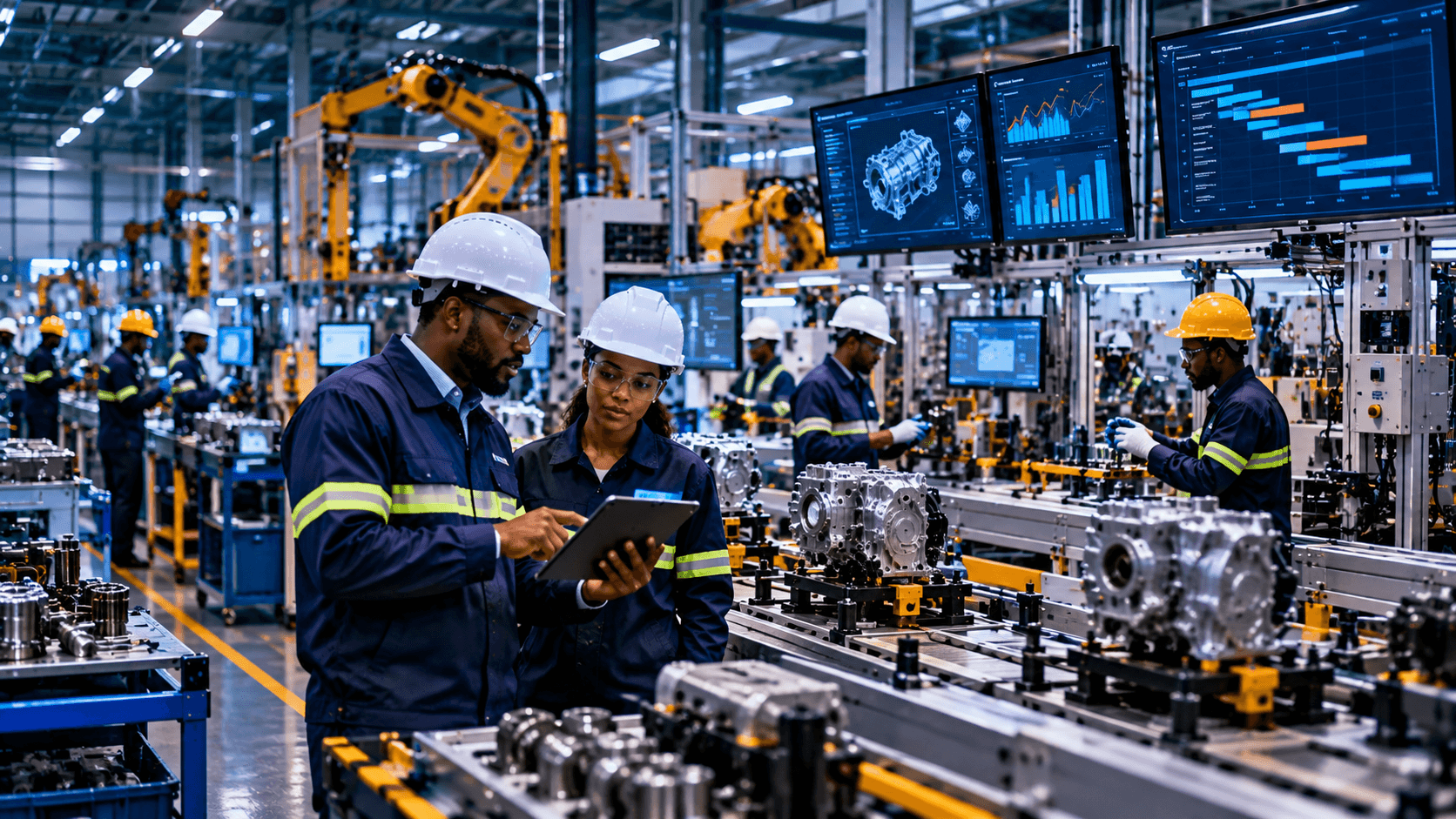
Concept illustration only — no live factory data or performance claims.
THE MANUFACTURING REALITY
A reliable production plan needs materials, capacity, equipment, trained people and quality controls to come together at the right time.
Disconnected planning, production, maintenance, quality and inventory records can hide bottlenecks, delay response to breakdowns, create avoidable scrap and leave managers working with yesterday’s picture.
We examine the flow from demand to dispatch, including the handovers between planning, procurement, production, engineering, quality, warehouse and commercial teams.
END-TO-END MANUFACTURING
We understand the operating processes that connect planning, execution, assurance and fulfilment.
Connect demand forecasts, sales and operations planning, master production schedules, capacity planning, material requirements, work-centre constraints and production sequencing.
↗Coordinate work orders, routings, bills of materials, batch or lot records, operator instructions, shift handovers, output reporting, downtime reasons and work-in-progress.
↗Support incoming inspection, in-process checks, final inspection, sampling plans, non-conformances, corrective actions, deviations, rework, scrap and product release records.
↗Coordinate asset registers, preventive and corrective maintenance, work orders, breakdowns, inspection findings, spare parts, maintenance schedules and downtime analysis.
↗Improve visibility of raw materials, components, work-in-progress, finished goods, lot and serial traceability, stock locations, replenishment, shelf life and material shortages.
↗Connect requisitions, approvals, purchase orders, supplier delivery commitments, certificates, goods receipt, supplier non-conformance and supplier performance reviews.
↗Coordinate packaging instructions, label and batch verification, palletisation, finished-goods put-away, order allocation, dispatch checks and customer delivery records.
↗Use production, quality, maintenance and material data to investigate recurring losses, support root-cause analysis and track improvement actions.
↗THE PRODUCTION LIFECYCLE
Manufacturing environments differ by product, process, risk and regulatory context. A useful digital workflow respects validated procedures, defined authority and the boundary between enterprise systems and control systems.
Demand signals, customer orders, forecast review, S&OP and production capacity assumptions.
Master production schedule, MRP, BOMs, routings, labour, work-centre capacity and materials availability.
Supplier qualification, purchasing, incoming logistics, goods receipt and incoming quality checks.
Work-order release, setup, changeover, material issue, production reporting and work-in-progress control.
In-process and final inspections, test results, non-conformance handling, release and traceability.
Preventive maintenance, breakdown response, condition checks, spare parts and equipment reliability.
Finished-goods storage, order picking, packaging, dispatch, shipping documentation and delivery.
Performance review, root-cause analysis, corrective actions, standard work and continuous improvement.
INTELLIGENT BUSINESS SYSTEMS
Automation should reduce friction and improve the quality of decisions without compromising established operating controls.
Bring planned work, actual output, work-in-progress, bottlenecks and exceptions into a more consistent operational view.
Link inspection results, batch or serial references, deviations, non-conformances and disposition decisions to accountable records.
Make asset status, maintenance requests, work orders, spare-part needs and outstanding actions easier to coordinate.
Connect production demand with stock availability, purchasing, supplier commitments and replenishment actions.
Turn agreed source data into understandable indicators, trends and exception reporting for supervisors and decision-makers.
Assess practical connections between business systems and industrial platforms using available, approved interfaces and clear system boundaries.
OPERATIONAL PERFORMANCE
Use agreed definitions and reliable source data to understand production effectiveness, quality, reliability, materials and customer service.
Availability × performance × quality
Output accepted without rework
Actual output against production plan
Material and quality loss
Lost production time and causes
Reliability and repair duration
Recorded stock vs. verified stock
On-time, in-full customer delivery
Time to switch product or setup
Quality, delivery and responsiveness
Energy used per output unit
Inspections, incidents and action closure
MANUFACTURING TECHNOLOGY & METHODS
These are common manufacturing technologies, methods and standards that may be relevant to a client's environment. Actual scope depends on the production process, sector, installed systems, security rules and applicable regulations.
Intellixio does not imply direct control of PLCs, SCADA, DCS or safety instrumented systems by default. Any industrial integration must be assessed with the client’s OT/IT, cybersecurity, engineering and safety teams, using approved interfaces and change-control procedures. Digital workflows do not replace validated controls, competent personnel or statutory obligations.
HOW INTELLIXIO CAN HELP
Support inventory, purchasing, suppliers, customers and operational reporting where those capabilities match the manufacturer’s requirements.
Explore OPS ↗Explore scoped connections between business applications, order channels and downstream workflows where suitable interfaces are available.
Explore Connect ↗Design practical workflows, reporting and integrations around production support, supply coordination and existing business processes.
Explore custom systems ↗Product fit, industrial connectivity and integration feasibility are confirmed during discovery. Listing a platform, standard or method does not imply an existing out-of-the-box integration, certification or validated manufacturing function.
START WITH THE PRODUCTION REALITY
Let’s map the workflow, systems and recurring production constraints — then identify a practical place to begin.